
The Neak Ta is conceptualized as the preeminent non-human entity within Cambodian communities, holding a unique status that transcends a simple spirit, as it is understood to be simultaneously the land and the people (Ang Choulean, 2000). This figure is fundamentally an ancestor who first entered the primeval forest, initiating the founding of the village and enabling the cultivation of crops, thereby ensuring agricultural productivity that could sustain successive generations on that same land.
Consequently, a major annual ritual, known variously as Leung Neak Ta (Ascending the Neak Ta), Leung Lok Ta (Ascending the grandfather), Leung Méakh (Ascending the [name of month/season]), or Som Teuk Phlieng (Asking for Rain), is performed each year. This ceremony is conducted following the completion of the rice harvest to express honor, acknowledge the power, and offer gratitude to the Neak Ta as the community’s sovereign guide. The ritual specifically thanks the Neak Ta for having provided sufficient rainfall to nourish the previous year’s agricultural cycle.
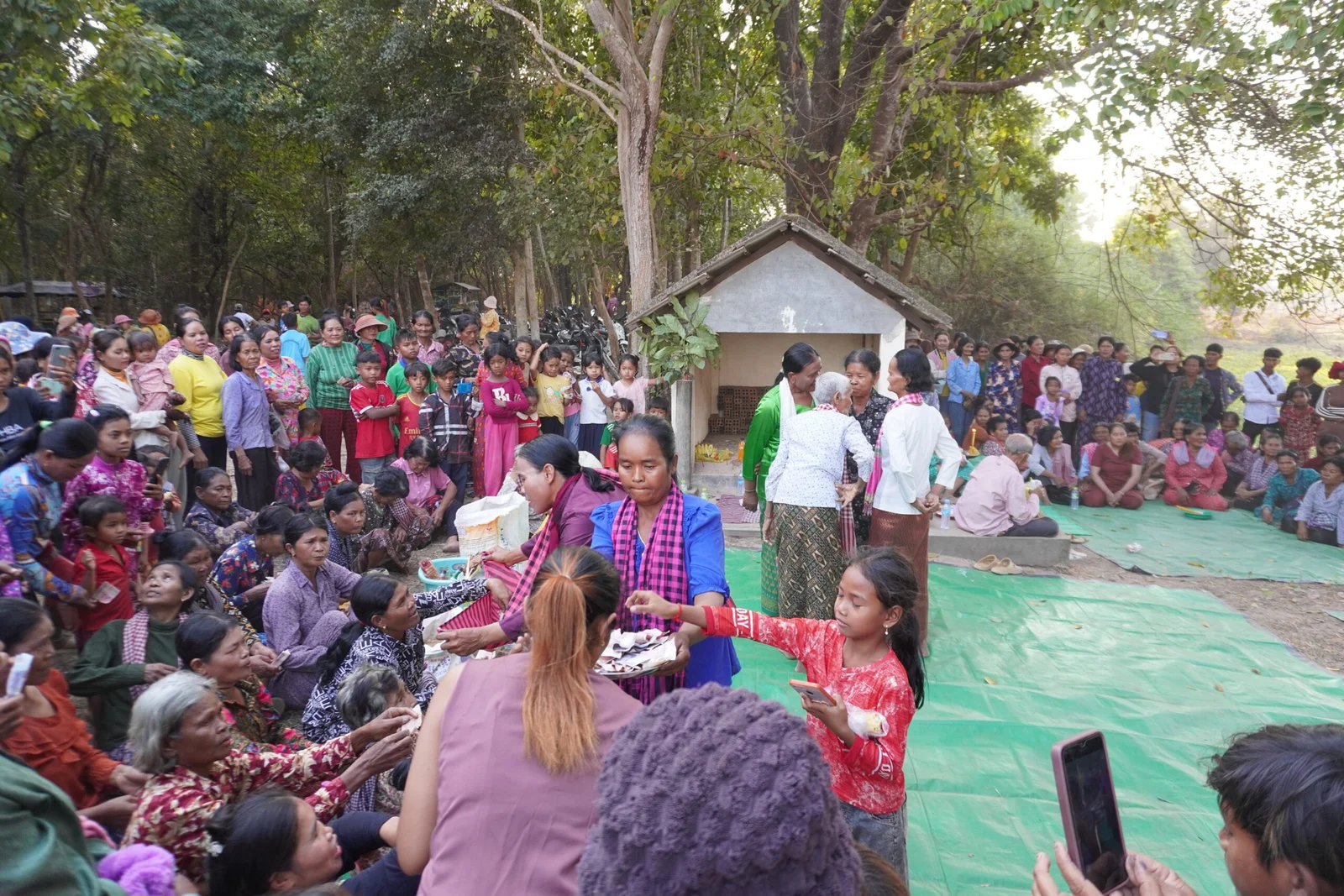
Crucially, the ceremony allows the villagers to establish direct communication with the Neak Ta through a spirit-possession ritual (Banhchoin Roup). This interface is utilized to articulate communal concerns, particularly those related to agriculture. The primary objective is to request a full and generous rainy season for the upcoming cycle, ensuring the new rice crop flourishes. Furthermore, the ritual serves as an opportunity for the community to invoke the Neak Ta‘s spiritual energy to expel all forms of misfortune and malevolent forces from the village, securing peace, prosperity, and an abundant harvest for the year ahead.
Furthermore, the ritual space for the ceremony is invariably situated directly in front of the local Neak
Ta shrine (spirit house). Every village within the region under investigation possesses such a Neak ta shrine. These structures vary in their construction, with some built of wood and others of concrete, typically featuring corrugated iron roofing (Figure 1). While some villages maintain more than one Neak Ta shrine, the full-scale communal Leung Neak Ta ceremony (the spirit propitiation ritual) is not performed for all of them. The large, significant ritual is customarily reserved for the Neak Ta believed to possess the greatest spiritual power and influence, often considered the principal or founding guardian spirit of the locality. Other, lesser Neak Ta spirits may receive only minor, simplified offerings and rites.
Why do locals choose the Neak Ta shrine as the location to perform the Leung Neak Ta ceremony?
Mao Sithibunnavadh (2015:20-40) posits that the community’s choice to conduct the Leaung Neak Ta ceremony at the Neak Ta shrine is rooted in the deity’s functional association with agricultural land and productivity. The Neak Ta is conceptualized as the epicenter of crop yield and agricultural stability. The latent energy within the Neak Ta requires human intervention to be actively disseminated. Consequently, villagers perform the ritual to access and mobilize this power, effectively positioning the Neak Ta as the spiritual guarantor of the harvest, and the participants as agents drawing on that energy. The specific ritual performance is designed to ensure the diffusion of the Neak Ta‘s energy across the communal rice fields, thereby securing a bountiful harvest. Reinforcing this link between the deity and the land, the Neak Ta symbolizes the cultivable soil. Hence, performing the ceremony in front of the shrine, or placing ritual stones within it, is symbolically analogous to the act of sowing seeds directly into the rice paddies (Mao Sithibunnavadh 2015:35).
- Participants
The successful execution of this ritual is entirely dependent on human engagement, as individuals are responsible for initiating and organizing the rite, and subsequently drawing the requisite energy from the Neak Ta. Participants in the Leung Neak Ta ceremony constitute a specific hierarchy, which includes the ritual head (Chao Mueng), the Medium (Roup Snorng), the Attendants (Snom), the instrumentalists (Neak Phleng), and the general community members and farmers (Kon Srok Kon Srae)
Who is the Chao Mueng?
The term Chao Mueng designates an elderly male figure vested with the knowledge and authority to orchestrate the ritual, ensuring its proper and standard execution. While their function parallels that of the Acharya (master of ceremonies), the Chao Mueng‘s appointment is secular, emerging either from communal selection or by serving as the designated ritual manager within the village, rather than being linked to the Buddhist monastic system. The term Chao Mueng itself is derived from Siamese influence dating back to the Middle Period, historically signifying a high-ranking regional official (e.g., ‘head of the district’ or ‘provincial governor’). Consequently, within the Leung Neak Ta ceremony, the Chao Mueng acts as the primary leader and organizer, whose presence is essential for the smooth progression of the rite. Typically, a single village or ceremony may involve multiple Chao Muengs. The comprehensive study across 15 surveyed villages (encompassing both Khmer and Kuoy ethnic groups) confirms the ubiquitous role of the Chao Mueng in leading the proceedings. Crucially, Chao Muengs possess a precise and detailed comprehension of every ritual component, carrying out the practices as they have been learned and transmitted through intergenerational heritage.
Who is the Roup Snorng (Medium)?
The Roup Snorng, often abbreviated to Rup, is the designated individual who serves as a conduit for communication between the human and spirit realms, facilitating spirit possession. Mediums can be of either sex—a phenomenon described by the local observation that a “male spirit [may be] possessing a female medium or a female spirit [may be] possessing a female medium.” The specific characteristics and mannerisms assumed during possession are typically retained across generations and are unique to each Roup Snorng.
Upon possession by a spirit (Neak Ta), the medium’s behavior alters noticeably from their baseline personality. Some Rup Snorngs may engage in ritual consumption of alcohol or tobacco and modify their clothing to align with the perceived gender of the possessing Neak Ta. Other mediums manifest distinct temperaments, such as displaying flirtatious gestures, engaging in petulance, or expressing anger, often soliciting placation from others. These behavioral shifts are key indicators that the spirit has successfully embodied the host. Furthermore, specific attire—such as wrapping a cloth into a kben, donning a head wrap, and wearing a waist sash—signals that the possessing spirit is male.
During a single Leung Neak Ta ceremony, one Roup Snorng may be inhabited sequentially by multiple Neak Ta or spirits, with each entity distinguishable by its unique demeanor and mannerisms. In certain instances, attendants (Snom) directly seek identification from the possessing entity by inquiring, “What is your name, Grandfather?”
The field research revealed the presence of both male and female Roup Snorngs (mediums) across the surveyed villages. A general observation, however, indicates a demographic prevalence of female mediums over male mediums. Notably, male Rup Snorngs are often associated with hosting the most potent Neak Ta (local spirits), a pattern documented in villages such as Sambor, Chei, Chong Prei, and Prei Preah.
Furthermore, spiritual cosmology in each village is characterized by a multiplicity of Neak Ta, with some communities believing their number to reach as high as 121. Crucially, within this extensive pantheon, one Neak Ta is invariably recognized as possessing the paramount power in the locality. This most powerful spiritual entity is the specific anumanussa (spirit) for whom the Leung Neak Ta ceremony must be organized and performed.
A salient feature of this ritual system is the establishment of Roup Snorng (medium) lineage, with individuals inheriting their role through patrilineal or matrilineal succession. For instance, in Chong Prei and Prei Preah Villages, the sole medium, a male named ‘Thim,’ inherited the spiritual function from his father.
Crucially, the concept of lineage extends beyond the human medium to the Neak Ta (spirits) themselves. A case in point illustrates this: ‘Ta Pich,’ the paramount Neak Ta of Cheay Sampov Village, is the biological younger brother of ‘Ta Mok,’ the most powerful Neak Ta in Chei Village. These two figures are understood to be the offspring of ‘Yiey Reach’ and ‘Ta Thoang.’
This sibling relationship dictates the temporal organization of the rituals. A communal belief mandates a ritual prohibition (trornom): the ceremony for the junior Neak Ta, Ta Pich (Chey Sampov Village), must be fully completed before the ceremony for the senior neak ta, Ta Mok (Cheay Village), can commence. This ancient tradition—prioritizing the ritual for the less powerful younger brother—is theorized to stem from the recognition that the elder Neak Ta possesses greater spiritual influence, necessitating the subordination of the junior’s ritual. This protocol parallels modern formal events where lower-status individuals present first before the presiding dignitary delivers the main address, or where high-status individuals are accustomed to not cutting the ribbon first at inaugurations.
The spiritual hierarchy is further underscored by inter-village ritual cooperation and spatial arrangements. The Ta Pich ceremony requires the presence of the Ta Mok medium (from Cheay Village) as a presiding figure, and conversely, the Ta Mok ceremony requires the Ta Pich medium (from Cheay Sampov Village) to assume a similar role. Decades ago, the Ta Mok ceremony involved an elaborate Arak music procession, with villagers trekking to ‘Boeung Kumpout Khlout’—a location marking the border between the two villages—to ceremonially welcome the arrival of the Ta Pich medium. This journey from Cheay Sampov to the border traversed three significant landmarks: Trapeang Kou Slab, Trapeang Andoung Bei, and Trapeang Chhes Khaol. Finally, the seniority is physically enforced during the rite, as the medium hosting Ta Mok is required to be seated at a higher elevation than the medium hosting his younger brother, Ta Pich (See Figure 3).
A further significant observation is that each Roup Snorng (medium) possesses a unique collection of consecrated objects designated for veneration. These ritual artifacts are transmitted intergenerationally from preceding mediums to their successors. This collection is housed on a special shrine known as the ‘Hoeung Krou’ (Master’s Shelf) (Figure 4), which is mounted inside the residence of the Roup Snorng or the Snom (attendant). The Hoeung Krou is a platform, often constructed from contiguous planks, sometimes made of materials like bamboo or rattan.
The shelf serves as the repository for various ritual materials (randab), which typically include: white liquor (sra sor), small offering cups, orange soda, bananas, a principal slar thuor (betel set), two or four smaller accompanying slar thuor (known as slar thuor aom), a water vessel (toak), perfume, talcum powder, cigarettes, betel nut, candles, and incense sticks.
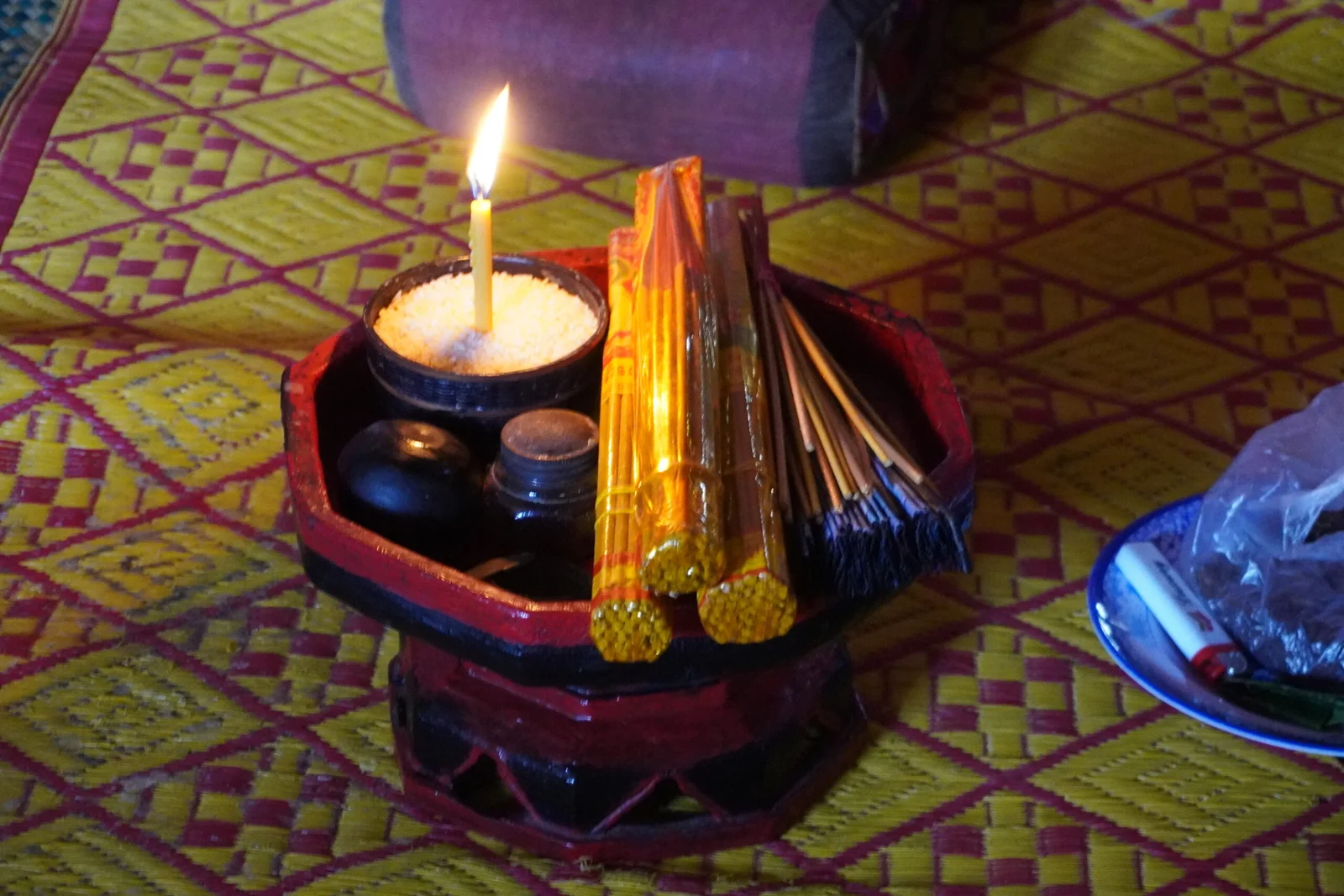
Among the enumerated sacred objects, the Toak (pedestal container) is critically essential, serving as a material anchor for the Roup Snorng (medium) during the possession trance. To facilitate the entry of the Neak Ta (spirit), the medium grips the Toak while entering a state of intense, non-ordinary concentration. Therefore, the Toak functions as the conduit that enables the spirit to cross the ontological boundary and possess the medium’s physical form; it similarly facilitates the spirit’s departure upon the conclusion of the ritual. The Toak itself is a blackened, lacquer-painted wooden vessel resembling a traditional Khmer pedestal tray (cheung pean). It is designed to contain several core ritual items, including incense, candles, consecrated wrist-tying thread (ambaos dai), small cups, wax tongs, oil, a miniature dagger (koun sien), and money (Figure 5). Fieldwork observations revealed a variation in practice: while some mediums retain the traditional wooden Toak, others who lack the specific artifact have substituted it with a pdeil (bowl) filled with rice and surmounted by a lit candle. Despite this material substitution, the functional continuity is maintained, as the replacement bowl is still ritually referred to by the name “Toak.”
Beyond the primary offerings, the Roup Snorng‘s (medium’s) residence houses several other significant artifacts, including the teap (offering tray), Arak drums, chapei (long-necked guitar), and swords.
The Arak drum (skor arak) is a type of ‘earthen drum’ (skor dei), constructed from fired clay and faced with the skin of a snake or monitor lizard. Each medium typically owns three to four of these drums, which are integral to the Leung Neak Ta and Lieng Arak (spirit feeding) ceremonies. A separate, specialized instrument is the Skor Chhvea (Javanese or long drum), a wooden, elongated drum with two faces covered in deerskin. These drums are always played in a pair by two musicians seated opposite one another, exclusively during the Lieng Arak ritual, particularly during the symbolic ‘boxing match’ between the Arak master and the disciples.
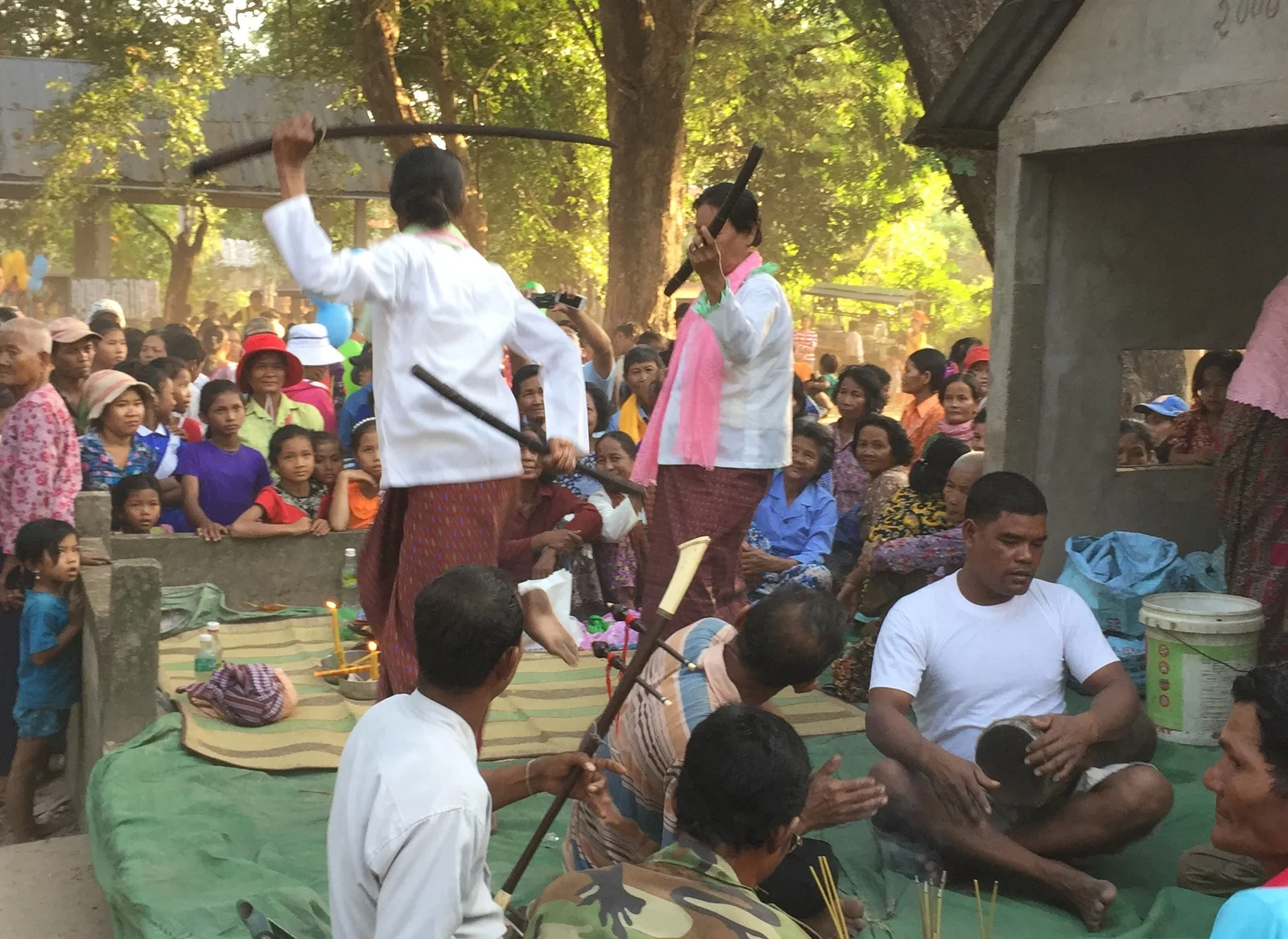
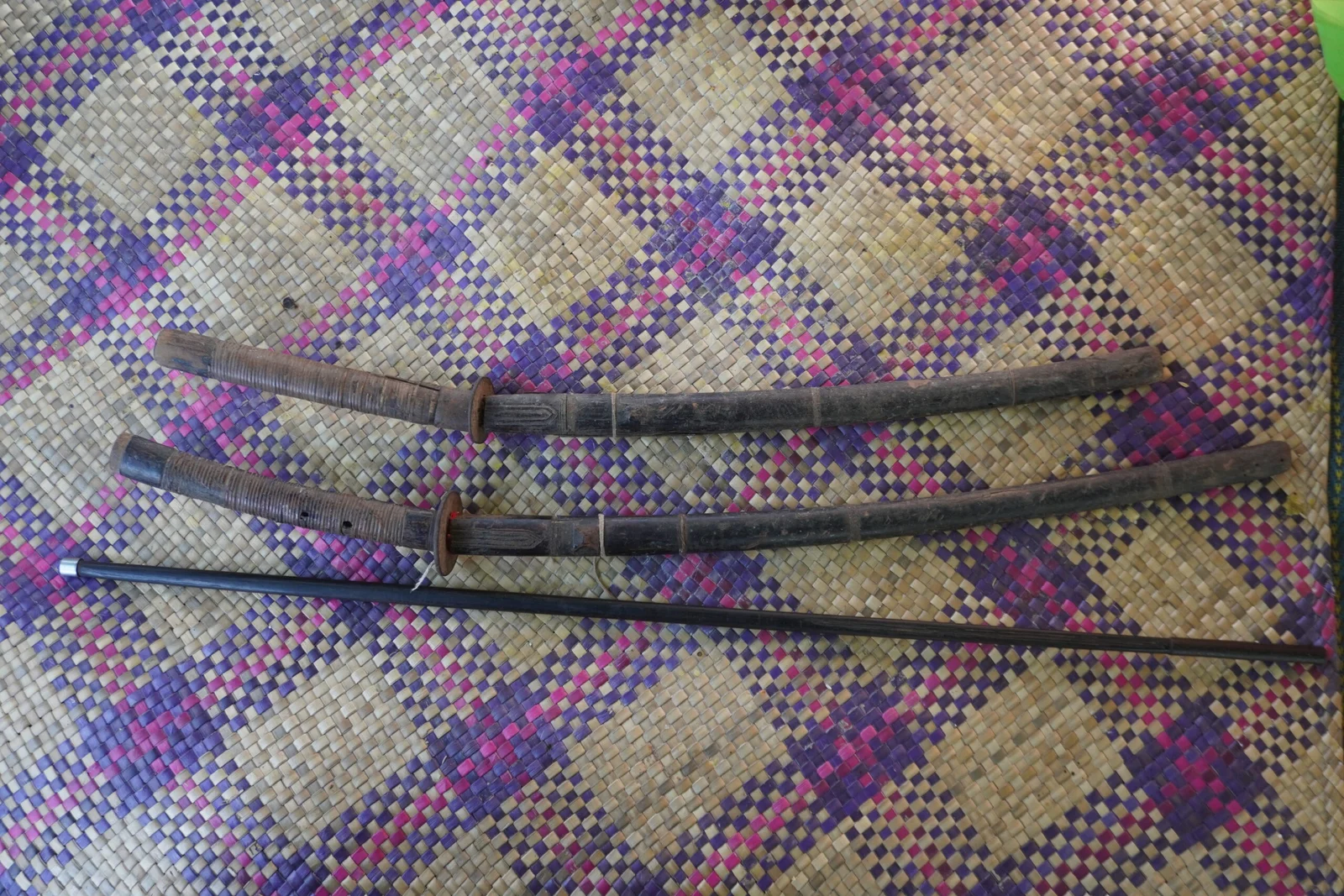
The sword, usually a pair of iron swords (sometimes termed ‘male and female swords’) (Figure 6), is particularly important, signifying the rank and power of the anumanussa (spirit), given the belief that some Neak Ta are powerful generals or warriors. While swords are generally employed in the Lieng Arak ritual, their use varies between villages during the Leung Neak Ta ceremony. In Chei Village, the medium actively brandishes the swords during possession (Figure 7). However, in Cheay Sampov Village—despite the Neak Ta‘s lineage connection to Chei Village—the swords are merely placed before the medium without the associated ritual dance. Regardless of their performative use, both the medium and the community hold a collective belief in the sword’s profound sacredness. Consequently, a prohibition exists against removing the swords from the local district, rooted in the conviction that such an act would invite misfortune upon the community.
Source By: MANG Valy, AN Raksmey, SREI Sambunnarong
Supported By: UNESCO Participant Programme 2024-2025
Leave a Reply